
If you’ve ever had a dog (or cat) roll over and offer their belly, you already have a clear picture of love as access. It is a form of intimacy. That gesture — completely unguarded and voluntary — is a perfect example of what love does: it opens and offers access. It says, here is a vulnerable part of me, and I’m choosing to share it with you.
Love, Intimacy, and Access
Think about the people in your life who have real intimacy with you. They know your actual unfiltered thoughts — not the curated version you present to most people, but what you genuinely think. They have access to your inner world, your fears, your hopes, your unguarded self — the parts you don’t hand out to just anyone.
The same pattern holds in your physical space. Delivery people you might chat with in the front yard. Neighbors might get invited onto the porch, and friends into the living room. The people you trust most are the ones who make it to the private rooms — the spaces that aren’t on display for just anyone.
This pattern holds with your physical body too. A handshake is access that might be given to a passing acquaintance. A doctor or masseuse has a different kind of access, which is granted for a specific purpose. And a lover has access that exists because of an entirely different depth of trust.
Every one of those is a form of access, and every one of them exists because of trust. Love is what builds that trust. And trust is what makes the opening (access) possible. Every layer of intimacy is a layer of access made possible by the recognition of source in one another — and love is that recognition at its fullest. And that means, at its most precise: love expresses itself as access.
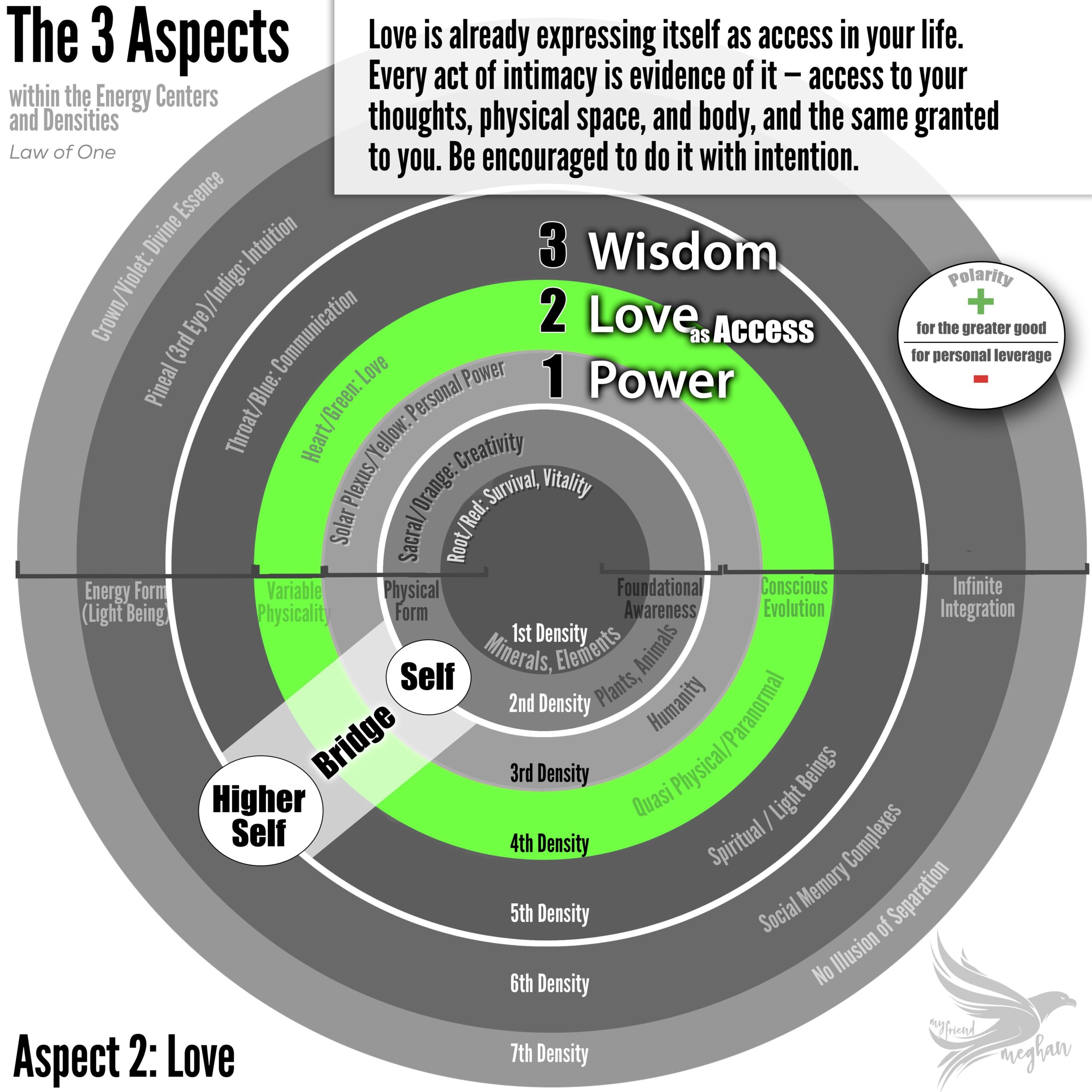
Access is always a choice — you choose to open, you choose to let someone in — which means love, at its core, is an exercise of power. Additionally, whether of not you receive the access someone has offered to you is always a choice. And the direction you take that power with both those forms of access (in the giving or receiving) is where polarity enters the picture.
The Sacred Nature of Access
It is worth pausing here to ask why access granted through love is sacred — and why forced access is a violation at the deepest level.
Every person you encounter is an extension of source — created by it, sustained by it, an expression of it. And source, at its core, is love. That means when you see the creator in the person in front of you, you are recognizing what they actually are — this is recognition, not projection. And when access flows from that recognition, it is sacred because it is source choosing to be known by source. It is oneness, in practice.
Forced access refuses that recognition entirely. It treats the other person as an object to be entered rather than an expression of source to be met. The door was never unlocked. It was breached.
The Two Polarities
Access is inseparable from free will. You can offer access, but it is the other person’s free will whether they choose to receive it. And you can be offered access, but it is your free will whether you choose to accept it. When either side of it is overridden — access taken without being offered, or access forced on someone who didn’t choose to receive it — that’s where polarity comes into focus. And understanding that difference is key to understanding what love as access looks like in practice.
That distinction comes down to this: has access been given and received freely, or has it been taken or forced?
1. Love: Access Given or Received Freely
Operating in love means your side of the exchange is freely given — and that is what you have sovereignty over. You can offer access that isn’t received, and that is still love in operation. You can be willing to receive access that isn’t offered, and that is still love in operation. What distinguishes this path is simply how you show up — offering freely, receiving willingly, and honoring whatever access you are given. Here is what that might look like:
- Sharing what is actually true for you, rather than a curated version designed to manage the other person’s response
- Receiving what someone shares without filtering it through whether it matches what you hoped they’d say
- Letting someone’s love for you land, rather than deflecting it or holding it at arm’s length
- Honoring the access you’ve been given by using it for connection rather than leverage
- Accepting what you find — in yourself and in others — without requiring it to be different
- Granting access to your physical space — like offering your guest room to a close friend’s sister visiting from out of town — because the trust in that relationship extends naturally to those they love
2. Force: Access Taken or Forced
Operating in force means your side of the exchange is not freely chosen — it is imposed on others or extracted from them. You can take access that wasn’t offered (e.g. unwanted sexual advances). You can force access onto someone who didn’t choose to receive it (e.g. a flasher). What distinguishes this path is how you show up — taking without consent, imposing without invitation, and treating access as something to be seized or leveraged rather than exchanged. This might look like:
- Pressuring someone to share more than they are ready to share
- Using what you know about someone — information they gave you in trust — to manipulate or control them
- Asking loaded questions where only one answer is acceptable, using the relational access you have as the pressure
- Withdrawing love or connection as a consequence for someone not opening the way you wanted them to
- Sharing a private family issue with someone you have only a passing acquaintance with, who has not indicated they want a deeper level of intimacy with you
- Venting about a hard day to someone without first checking whether they have the capacity or desire to receive it
- Pressuring a neighbor to come inside despite their refusal, using your warmth and insistence to override what they actually said
- Insisting on putting more food on a guest’s plate after they’ve declined, continuing to push until they feel forced to eat it
Mixed Polarity in Practice
In real relationships, both polarities are rarely operating at the same level at the same time. More often, one person is offering or receiving freely while the other is taking or imposing. Recognizing which energy you are operating in — regardless of what the other person is doing — is the whole point. Your polarity is always yours to choose.
Example 1: Prayer Request
Under the guise of a prayer request, someone shares an extensive story about people you may know — intimate details of their lives that you had no right to know and no interest in knowing. In this instance the person sharing may genuinely believe they are operating from love and concern. But two force violations are happening simultaneously. First, they are granting you access to information that is not theirs to give — they are opening a door into someone else’s inner world without that person’s consent. Second, they are imposing that access on you without checking whether you have any interest in receiving it. Your free will as the receiver has been bypassed entirely. The intention may have been love. The mechanism is force.
Example 2: Food
Your host has worked hard on a meal and wants you to enjoy it. From their side, the offer of seconds comes from a genuine place of love and generosity. But you decline. In that moment you have communicated something important: the way they can best love you right now is to honor your no. When they push past that — insisting, putting food on your plate anyway, continuing “encouraging you” until you feel forced to eat it — two violations have occurred. First, they have ignored the boundary you set over your own experience, overriding your free will about what you want to receive. Second, by continuing to push until you physically comply, they have crossed your physical boundary — your body, and what goes into it, is yours to govern. Their love may have been real. But the mechanism became force the moment your no was not honored.
Force in its more obvious forms is relatively easy to identify. What is harder to see is the space in between — where the intention is genuinely love, but the mechanism has quietly slipped toward control. That is where something I think of as “the conditions trap” also lives.
The Conditions Trap
Much like the kindness trap — where most people would genuinely argue they don’t try to control things, yet unintentionally find themselves doing exactly that — the conditions trap operates the same way. Most people genuinely believe they offer love freely, and they mean to. But almost all of us, at some point, attach conditions without realizing we’re doing it.
One of the places the conditions trap tends to show up most often is in financial gifts. Consider a situation where someone has an unexpected financial need — a car repair the is going to be expensive. Due to circumstances beyond their control, they don’t have it. A loved one offers to give the money to them — not as a loan, just a gift — and they accept. The repair gets done. But shortly after, the person who gave it starts weighing in on their spending. They bought organic produce? They bought a name brand something? “Since I gave you that money,” the giver says, “I think you should be more careful.” What felt like a gift has quietly become a leash.
This is the conditions trap in one of its most common and least recognized forms. And it operates in two ways.
- The first is spoken conditions — “I’ll give you this, but you need to do X, Y, or Z.” Most people feel entitled to attach these, and in a purely practical sense they may argue they have the right to. But what is actually happening is that a position of power (in this example, financial) is being used to control another person’s choices and behavior (in other words tampering in their sphere of influence). That is force operating from an advantage.
- The second is unspoken conditions — the gift is given freely in the moment, but conditions surface afterward that were never disclosed (like our example with the car repair). This is arguably the deeper violation, because the receiver never had the opportunity to decline the gift on those terms.
Conditions and Others
The principle underneath both is simple: the moment a gift leaves your hand, your jurisdiction over it ends. What the receiver does with it is theirs to determine — even if it isn’t what you would have done. If you don’t like how the gift (in this example, money) was used, your choice is whether you choose to give again in the future. Attempting to control what happens after the gift has been given is leveraging the access that power created and is a boundary violation, which is force — regardless of how loving the original impulse was.
The financial example is one of the more visible expressions of the conditions trap, but the pattern itself runs through every form of love we offer. Anytime what we are offering is conditional love — I will love you if, I will accept you if — we have moved out of love as access and into control (a free will violation). Unconditional love, by contrast, grants access without a price tag attached.
When we are offering conditional love in any form — we have fallen into the conditions trap. And it shows up in relationships in ways that often feel completely justified in the moment.
Consider a marriage where one partner can clearly see the potential in the other — the version of them that is fully healed, present, and capable of deep intimacy. If that partner — from that place of genuine love and genuine vision — spends years articulating that gap, “This is what I need. This is what I’m not getting. This is where you’re falling short,” the person on the receiving end becomes convinced they are failing. The partner doing the asking becomes increasingly miserable, and the potential they see has become a bludgeon, rather than being an invitation for them to rise to their potential (which ironically works in direct opposition of the goal the partner was after in the first place).
What changes everything is the moment you release the other person from your expectation. Not because you stop seeing their potential — you don’t. You hold it. You continue to see the highest version of them and you hold that energy as a real and living possibility. But you stop weaponizing the gap between that potential and their current reality. Stop withholding your love and acceptance based on the condition that they become the best version of themself. You accept them fully where they are, and at the same time that you hold the vision of who they are capable of being. Holding someone’s potential and their current reality simultaneously, without weaponizing the gap between them, is unconditional love. And paradoxically, it is that acceptance — not the pressure — that creates the space for them to actually grow into it.
Conditions and Self
That same principle turns inward too. Self acceptance is one of the most radical acts of self love. I will be kind to myself when I lose the weight. I will love myself when I finish the degree. These are the conditions trap directed at yourself.
The energy centers hygiene practice is built on unconditional acceptance: pause, check in, and accept what you find. Even when what you find is that you’re struggling, that you’re not where you want to be, that you’re having a hard time being kind to yourself in this moment — accepting what is actually there, rather than requiring it to be different before you’ll accept yourself, is love as access turned inward. It is the door you open to yourself.
The conditions trap doesn’t resolve in a single moment of awareness. It resolves in the ongoing practice of noticing where love has acquired a price tag — and choosing, again and again, to remove it.
Your Love, Your Access
Love operates everywhere that intimacy exists — in friendships, in community, in the relationship you have with yourself. Every time you choose to let someone into what’s actually true for you, you are exercising this capacity. Every time you choose to receive what someone offers without running it through a filter of conditions, you are exercising it too.
Love as access is already operating in your life — in every relationship where trust has built a threshold, in every moment where you have chosen to open or been invited in. The invitation this aspect extends is simply to bring intention to what is already happening. To notice where you are offering freely, where you are receiving willingly, and where love has quietly acquired a price tag you didn’t mean to attach.
Actionable Insights
- Notice the conditions you’re running. The next time someone you love shares something with you, pay attention to your inner response before you respond out loud. Are you receiving what’s actually there — or are you evaluating whether it matches what you hoped for? That gap is where conditions live.
- Look at the access you’ve been granted and ask how you’re using it. Think of someone who has opened up to you — who has let you into their real life. How are you honoring that? Are you using what you know about them for connection, or for leverage?
- Check where you’re controlling access to yourself. Is there a relationship where you’re carefully managing what the other person sees? Ask honestly: is that discernment about the level of intimacy that actually exists — or is it fear of what happens if they see what’s really there?
Note: The diagram accompanying this post is a derivative of the full energy centers and densities diagram. If you’d like to explore the complete framework, you can find it here.
Leave a Reply