
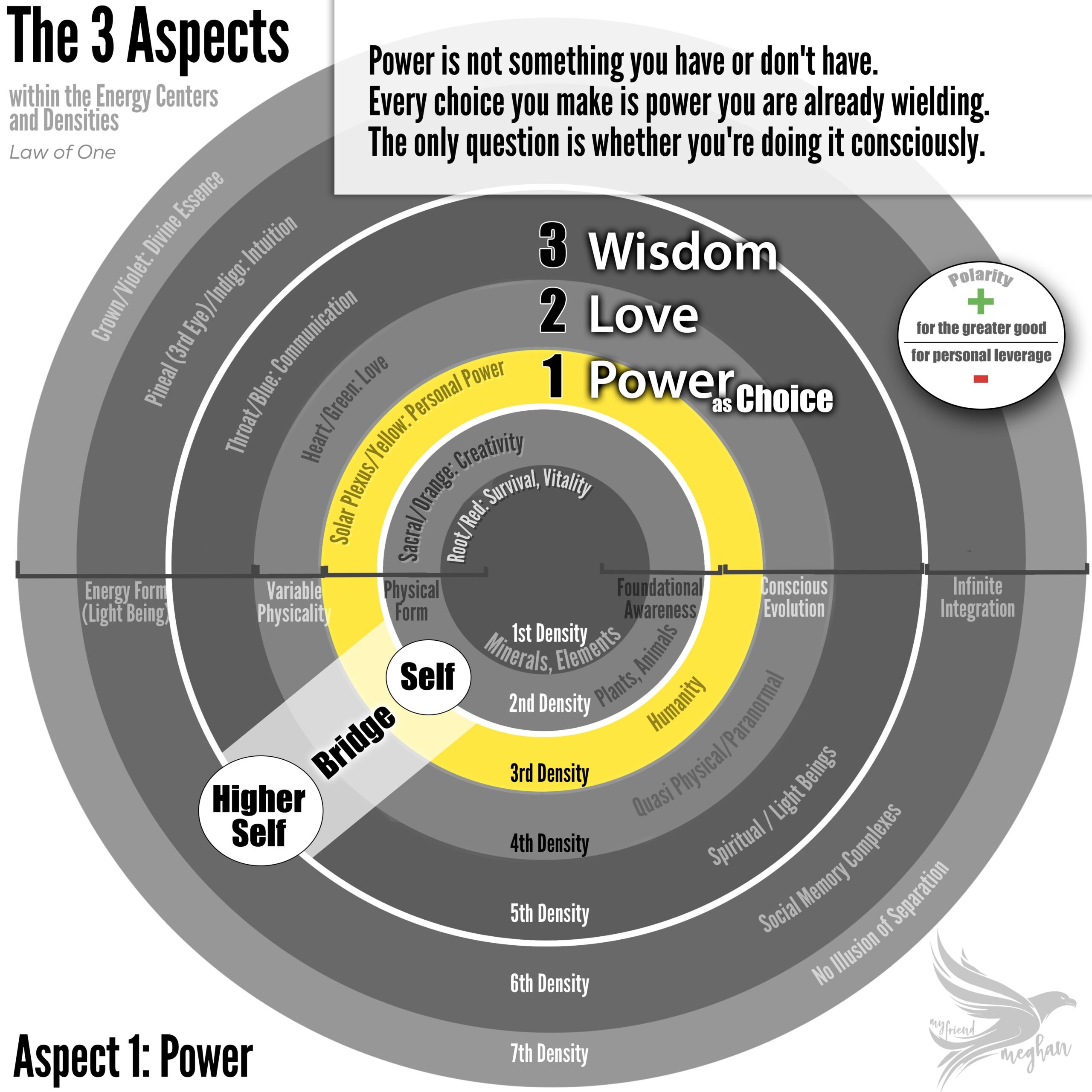
Power is one of those words that carries a lot of weight. And for good reason — because power is real, it is active, and every conscious being is already exercising it. The question isn’t whether you have power. You do. The question is what you’re choosing to do with it.
Which takes us to the crux of the matter, power is choice, and choice matters more than most people realize. Further, making those choices consciously and with intention matters — because every choice you make is an exercise of power, whether you recognize it as that or not.
What Power Actually Is
At its most fundamental level, power is the capacity to choose. This is why free will is treated as sacred across so many traditions and frameworks — because free will and power are not two separate things — free will is the exercise of power. Free will — the capacity to choose — is the most fundamental capacity available to you as a conscious being.
This is also why violating someone’s free will is such a serious matter. You’re not just overriding a preference. You’re taking their power.
Every conscious being gets to choose their own picnic — what they value, what they cultivate, what they allow to take up space in their experience. That is sovereignty. And sovereignty is what power looks like when it’s operating from the inside out.
The Two Polarities
Power, as a capacity, is neutral. What gives it direction is intention — specifically, the choice every conscious being makes about how to wield it. And that choice is, at its core, a polarity choice. Understanding polarity is key to understanding power, because the direction you take your power is determined by which polarity you’re operating from.
That choice comes down to this: are you operating for the greater good, or for personal leverage?
1. Greater Good
Operating for the greater good means using your capacity to choose in ways that honor your own sovereignty and the sovereignty of everyone around you. It means you rise — and you rise in a way that doesn’t require anyone else to fall. The greater good includes you. You taking care of yourself (self care, self love, provision, etc.) — it’s not about self sacrifice, this is you taking up your rightful space. These are not in conflict with the greater good, they are in support of it. What distinguishes this path is simply that your rising doesn’t come at the expense of others. Here’s some examples of what that might look like:
- Using your platform, your voice, and your power to lift others rather than position yourself above them
- Making decisions with the full picture in mind — not just your outcome, but the impact on those around you
- Collaborating and sharing resources, credit, and opportunity freely
- Honoring your own free will in addition to actively honoring everyone else’s personal sovereignty
2. Personal Leverage
Operating for personal leverage means accumulating advantage — using power to position yourself above others, to control outcomes, to ensure you come out ahead regardless of what it costs the people around you. It is a real expression of power, and it works in the short term on its own terms — but it operates at someone else’s expense. This might look like:
- Manipulating information to get a desired outcome
- Withholding resources to maintain control
- Taking credit for others’ work
- Using relationships transactionally — people are useful until they aren’t
- Making decisions that benefit yourself while externalizing the cost onto others, financially, emotionally, or energetically
- Using fear, guilt, or shame to move people in the direction you want them to go
This is not a small choice — it determines how you move through every relationship, every decision, and every interaction that follows. This is your power.
Most often, we recognize power when it’s being exercised in obvious ways. If someone’s orchestrating dominance or openly maneuvering for control — we see that very clearly. What we may miss is the more subtle implementation of power, which shows up in how people have a tendency to handle one another “with care.”
The Kindness Trap
This is a subtle and important piece, because most people will say “I don’t try to control things.” And they genuinely believe that. But almost all of us do — and we do it in the name of kindness.
Here’s what it looks like: you have something honest to say. But you’re worried it might hurt someone you love. So instead of just saying it, you start shaping it — softening the edges, adjusting your wording, trying to frame your moment — not to be clear, but to manage their response. To make sure they don’t get too upset. To avoid the reaction you don’t prefer.
That impulse may even come from a place of love, but the mechanism is a sphere of influence violation. Their emotional response to your honest truth lives entirely inside their sphere — not yours. When you start engineering your communication to control that response, you have crossed the line. You are now trying to choose on their behalf how they will feel, and that is not yours to choose. The moment you step outside your own sphere — even with the best of intentions — you are no longer exercising power. You are exercising force.
And here’s the harder truth: if difficulty and discomfort are the raw material of growth, then allowing someone to have a real, unmanaged response to your honest truth is actually one of the most loving things you can do. You’re trusting them with their own catalyst. You’re treating them as capable of handling their own experience. Softening it, shaping it, managing it — that’s you deciding, unconsciously, that they are unable to or you simply trying to do their work for them. And that is the opposite of honoring their sovereignty.
This is power as choice in its most intimate form. Every time you choose to resist the urge to soften, shape, or manage and simply deliver your honest truth, you are trusting them to handle what arises — including their own response. And that trust is active and intentional. When you see someone as capable of handling their own experience, you are actively calling that capacity forward in them. You are seeing them as the highest version of themselves, and giving them room to rise to meet it. That is sovereign power, exercised with love — and it is entirely your choice to extend it.
Your Power, Your Choice
“Power as choice” isn’t just relational. It’s in every single choice a conscious being makes, all day long, from the most mundane to the most significant. Whether you shower, what you eat, whether you rest, whether you speak or stay silent, whether you reach out or pull back. Every single one of those is an exercise of power. And most people are making hundreds of those choices a day without recognizing them as power at all.
Power is always in motion. Every choice you make — from the biggest decisions to the most ordinary moments — is an expression of it. The question is whether you’re making those choices consciously, and in which direction you’re pointing them — for the greater good or for personal leverage. The invitation here is simply to start choosing consciously, with full awareness of what you’re choosing and why.
Actionable Insights
- Notice where you’re engineering your communication. The next time you find yourself carefully shaping what you say to manage someone’s reaction, pause. Ask: am I being clear, or am I trying to control? Clarity is yours to offer. Their response is theirs to have.
- Find the line between your sphere and theirs. In any moment of tension or discomfort, ask: what is actually mine here? Your thoughts, your choices, your energy — those are yours. Everything else belongs to someone else’s picnic (their sphere of influence).
- Name your polarity. At any given moment, ask yourself honestly: am I operating for the greater good, or for personal leverage? No judgment in the asking. Just awareness. The intention you bring to your power is the whole thing.
- Pay attention to the everyday choices. The ones that seem too small to matter — whether you rest, whether you eat well, whether you tend to yourself — are power in motion too. Ask: am I choosing this, or am I just letting it happen?
Note: The diagram accompanying this post is a derivative of the full energy centers and densities diagram. If you’d like to explore the complete framework, you can find it here.
Leave a Reply