
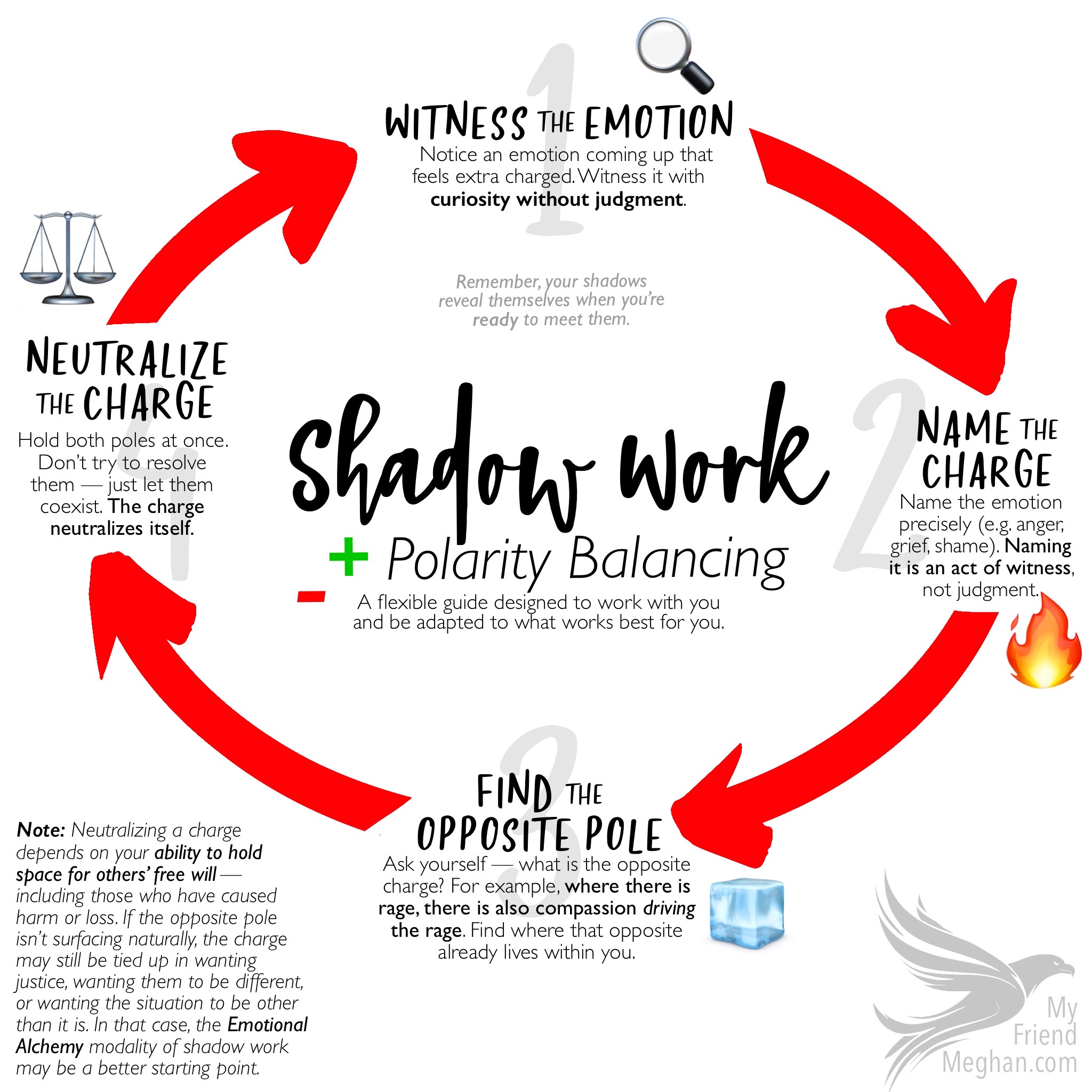
Shadow work isn’t one-size-fits-all. Not every trigger calls for the same tool, and part of growing in this practice is learning to recognize which modality fits the moment. This post introduces Polarity Balancing — a second modality of shadow work, and one that works very differently from Emotional Alchemy.
Where Emotional Alchemy is excavation-based — feeling your way down through layers to the root belief — Polarity Balancing is energetic. You don’t dig. You witness. You find the opposite pole of the charge you’re carrying, hold both simultaneously, and let the neutralization happen on its own.
How Polarity Balancing Works
Every emotional charge exists on a spectrum. Rage has an opposite pole. Grief has an opposite pole. Shame has an opposite pole. And here’s what makes this process so powerful: that opposite pole already exists somewhere within you, in the very same situation that triggered the charge in the first place.
You don’t have to manufacture the opposite emotion. You just have to find where it already lives — rage, for example, is often driven by compassion. You care deeply about something or someone, and that care is what’s fueling the fire.
Hold both ends of the spectrum in awareness at the same time without trying to resolve them. When you can genuinely do that, something remarkable happens: the charge neutralizes itself. You don’t force it. You just hold the space and and the balance happens naturally.
This is rooted in an understanding of polarity, which is so crucial to manifestation — that every experience exists within a full spectrum, and that our suffering often comes from being collapsed onto one end of that spectrum without access to the other.
The Four Steps
1. Witness the Emotion
Notice an emotion coming up that feels extra charged. Don’t push it away, don’t chase it. Just see it. Look at that. There’s something here. This step is about creating enough space between you and the charge to work with it rather than from inside it. Witness it with curiosity without judgment.
2. Name the Charge
Name the emotion precisely (e.g. anger, grief, shame, resentment). Not just “I feel bad” — get specific. Give it its precise name rather than leaving it as a vague uncomfortable feeling. Naming it is an act of witness, not judgment.
3. Find the Opposite Pole
Ask yourself: what is the opposite charge? For example, where there is rage, there is also compassion driving the rage. Find where that opposite already lives within you.
This is the step that requires the most honesty. You’re not looking for an emotion you think you “should” have. The opposite pole isn’t something you reason your way to or decide intellectually — it arises from a deeper place. It might be love sitting underneath fear. It might be grief sitting underneath anger. And your job is not to dismiss it or override it when it does surface. Don’t go to “that can’t be right” when something unexpected shows up. Don’t talk yourself out of it.
4. Neutralize the Charge
Hold both poles at once without trying to resolve them. Accept that both are real, both are present, both are valid. Just let them coexist.
And then — if you can truly hold that space — the charge neutralizes itself. The balance happens naturally. It can feel disorienting at first — one moment you were flooded with intensity, and the next it’s simply gone. That’s exactly what’s supposed to happen. You didn’t force it or talk yourself into anything. You just held the space.
What This Looks Like in Practice
I’ll share a real example because I think it helps to see this in action rather than just in theory.
I found myself unexpectedly working through a trigger when an atomic bomb sized amount of rage emerged and a layer of unforgiveness too. It seriously startled me because rage isn’t something I typically deal with, and neither is unforgiveness. If anything, I forgive too easily, so I was definitely surprised.
But I was also excited, because I’d already been talking about this work — and here was a live opportunity to see it in action. So I worked through the steps. I witnessed it. I named it — rage, specifically the impotent kind that comes from witnessing injustice you can’t correct. And then I asked: what’s the opposite pole of this? The answer that came was compassion.
The part that was especially revelatory for me was when I realized the compassion was coming from the same moment. My compassion was for my loved one that I was feeling the rage on behalf of. And the moment I found it — genuinely found it, not as a spiritual bypass but as a real thing. Recognizing both polarities already present in me — I held them alongside each other without trying to make one replace the other.
Then the most astonishing thing: the charge neutralized. Just like that. From boiling over with rage to completely settled, instantaneously. What followed was interesting too. Once I was neutralized and grounded, the forgiveness step that needed to happen was almost a no-brainer.
From that place of balance, I could see clearly: everybody has their own picnic. The person I was angry with was simply living theirs — making choices that didn’t align with my values, choices I didn’t prefer, choices I couldn’t control. And from a neutralized place, I could hold that truth without the charge.
A Note on Who This Works For
Neutralizing a charge depends on your ability to hold space for others’ free will — including those who have caused harm or loss. If you’ve developed the capacity to honor your own sovereign journey and everyone else’s, you’ll find Polarity Balancing accessible. If the opposite pole isn’t surfacing naturally, the charge may still be tied up in wanting justice, wanting them to be different, or wanting the situation to be other than it is. If that’s where you are, the Emotional Alchemy modality of shadow work may be a better starting point — and you can return to this one when the groundwork is in place. There’s no hierarchy here. Just different tools for different moments.
Actionable Insights
- Try it on a low-stakes charge first. Before you bring this process to your biggest triggers, practice with something smaller — mild irritation, a moment of impatience, a passing frustration. Get familiar with the steps and how neutralization actually feels before you bring it to the heavy stuff.
- Don’t manufacture the opposite pole — find it. The process only works when the opposite emotion is genuinely present in you, not when you’re performing it. If you can’t find it yet, that’s okay. Sit with the charge a little longer. It will surface when you’re ready.
- Notice what becomes possible after neutralization. Pay attention to what clarity, forgiveness, or perspective becomes available once the charge has settled. That’s the real fruit of this work — not just relief, but the grounded vision that follows.
Leave a Reply