
Most of us have been taught to sort our emotions into two piles — the ones that are okay to feel and the ones that aren’t. Fear goes in the bad pile. Joy goes in the good pile. And we spend a lot of energy trying to stay on the right side of that line.
But that framework misses something fundamental. Sorting charges into good and bad is a morality judgment — not a read on the charge itself. The charge was never the problem.
Every Charge Is the System Talking
Every emotion you experience — fear, rage, grief, excitement, joy, dread — is a charge. When those emotions rise, they’re there to give you information so you can make an informed decision — not to derail you or hijack your path.
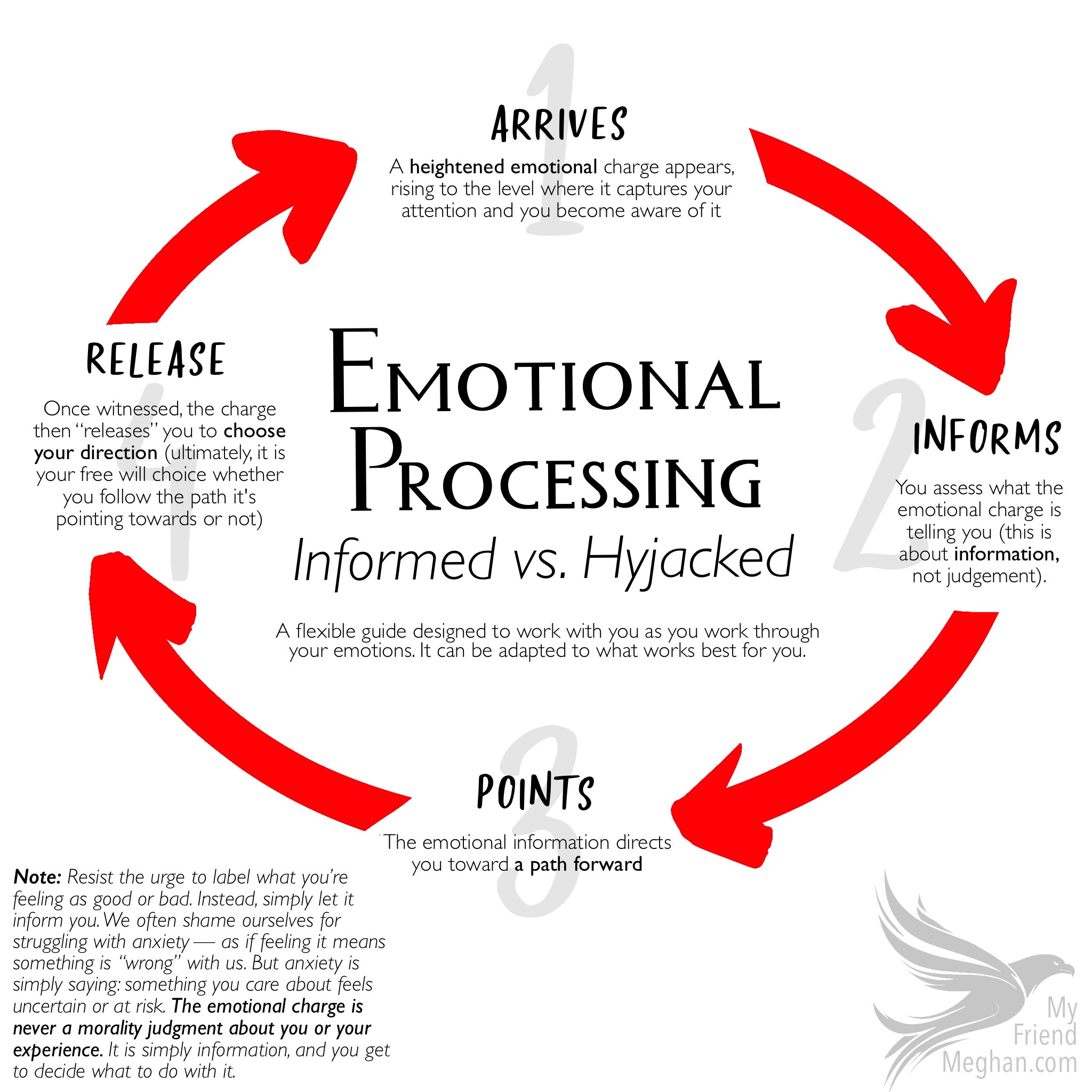
Every emotional charge moves through the same four stages when the system is functioning the way it’s meant to:
- Arrives — a heightened emotional charge appears, rising to the level where it captures your attention and you become aware of it.
- Informs — you assess what the emotional charge is telling you.
- Points — it directs you toward a path forward.
- Releases — it releases you to choose your direction (ultimately, it is your free will choice whether you follow the path it’s pointing towards or not).
Here’s what that looks like in practice. You’re walking and a car is suddenly heading straight toward you. Fear arrives — your body registers the danger and it has your full attention. It informs you that something needs to happen right now. It points you toward a path forward — get out of the way. And it releases you to choose. You run.
That’s the system working correctly. And you’ve likely already experienced this working behind the scenes in ways you may not have even realized. For those of you familiar with how the Higher Mind communicates, you’ll recognize this mechanic immediately — excitement sparks, it points you toward where you’re supposed to go, and the momentum of it accelerates you in that direction. It’s the same four stages. Every charge works this way.
Fear says: something needs your attention here. Joy says: something you deeply care about is in alignment. Rage says: something you care about deeply is being threatened. Grief says: something that mattered is being released.
These are simply emotions. They are not good or bad. If you are saying that an emotion is bad, what you’re really saying is that the charge is the problem. And the charge is never the problem. The charge is simply information, and you get to decide what to do with it.
Signal vs. Static
The same charge — the exact same fear, the exact same rage — can come through as clear signal (inform you) or dissolve into static (hijack your emotional state) depending on one thing: your baseline state when the charge arrives.
Your baseline state is the difference between flowing from a love-based, grounded place versus operating from a constricted one. It functions like the quality of a radio receiver. A well-tuned receiver picks up the signal cleanly. A receiver full of interference turns that same signal into noise you can’t interpret.
When your baseline state is grounded and open (unhindered), a “fear” response stays in the information lane. It tells you what you need to know, points you toward action, and moves through. You are informed by it.
When your baseline state is already constricted, that same “fear” emotion gets amplified and distorted. It stops being a messenger and starts making decisions — it runs the show. You are hijacked by it.
The good news is that your baseline state is not a permanent condition. This is something you have real agency over — and your level of crystallization plays a direct role in that. The more you build and strengthen your spiritual foundation, the more consistently you are able to receive the signal clearly, rather than being overtaken by the static.
The Principle in Practice
The real question to ask when a charge arises isn’t “is this good or bad.” It’s whether you are receiving it as a signal (inform you) or allowing it to become static (hijacking your emotional state). If you’re receiving it — if you can witness it with some degree of spaciousness, feel what it’s pointing toward, and respond from a grounded place — that’s a signal you are able to follow.
If you’re being hijacked — if you’re flooded, reactive, making decisions from inside the charge rather than from underneath it — that’s static, and that’s the moment to pause and reach for whatever practice helps you return to a grounded baseline. Shadow work and energy centers hygiene are a couple of the tools designed to help you return to a grounded baseline so the charge can do its job rather than run the show.
The goal isn’t a life without emotional charges. The catalyst these charges create have value. But the goal is a life where the emotional charges are able to do their job — informing you, pointing you toward a path forward, and releasing you to make decisions from a place of clarity rather than reaction.
Actionable Insights
- Start noticing the difference between being informed and being hijacked. When a strong charge arises, pause and ask: am I receiving this signal, or is it running me? You don’t have to answer it perfectly. Just developing the habit of asking builds the awareness that eventually makes the difference automatic.
- Use acceptance as your tuning mechanism. Whether you’re in a formal practice or just navigating a hard moment, receiving what’s present without layering judgment onto it is what keeps you in signal range. This isn’t spiritual bypassing — it’s how you stay clear enough to actually hear what the charge is telling you.
Leave a Reply