
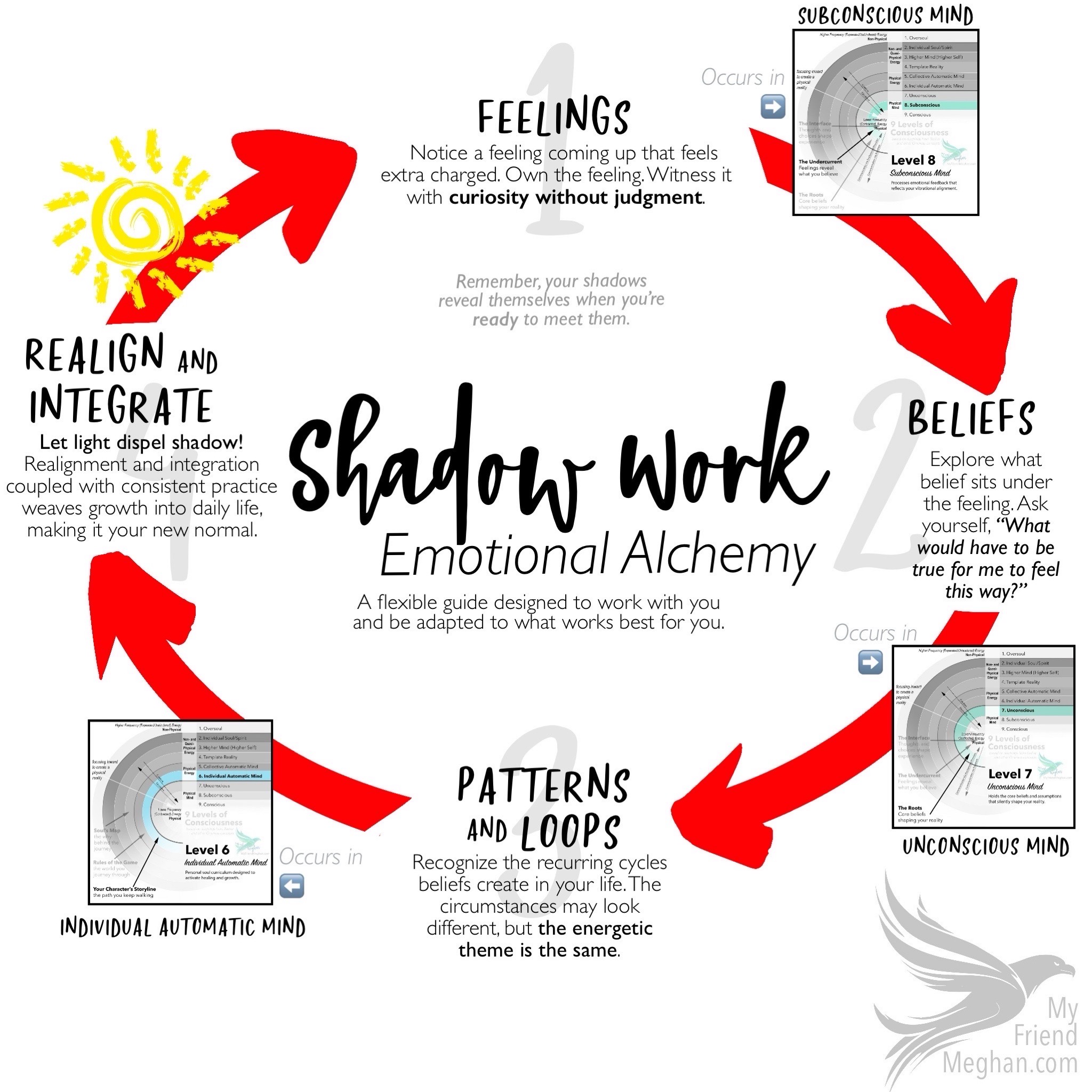
Shadow work has become a popular term in personal growth spaces, yet its true depth often gets lost in vague or trendy interpretations. At its core, shadow work is the intentional process of bringing unconscious beliefs, hidden emotions, and disempowering patterns into the light of awareness. It’s not about “fixing” yourself—it’s about reclaiming the parts of you that have been rejected, denied, or overlooked, and integrating them into your wholeness.
In a previous post, Shadow Work: Emotional Alchemy, we explored this process and the layers of healing it can uncover. This shadow work framework has four key steps, and in this series, we’re giving a bit more context and diving deeper into each one, giving you the context to work with each step more intentionally. This post focuses on when to do shadow work as well as overviewing the process.
When Shadows Come Into View
Your shadows reveal themselves when you are ready to meet them. You don’t need to hunt them down or make a list of everything you think is “wrong” with you—that approach comes from force, which is rooted in fear and carries a negative charge (be intentional to choose the polarity of your perspective). Instead, you can trust that if something surfaces—like a trigger in a conversation—it’s arriving because you’re ready to work with it. Shadow work is most effective when it begins from a place of self-love and curiosity.
This is where the Elevated Thought framework offers valuable insight. In an unhindered, love-based state, you’re in the flow, open to growth, and able to witness what arises with curiosity not judgment—creating a safe and supportive environment for the work to unfold.
By contrast, when you try to force shadow work from a constricted, fear-based state, you risk pushing yourself into things you’re not ready to address—potentially causing more harm than good. Not every shadow is meant to be faced immediately, but each one that appears offers an opportunity to heal, grow, and integrate another part of yourself into wholeness.
What Shadow Work Really Means
But let’s back up and dig a little deeper into what the term even means. Shadow work begins with the understanding that not all of our thoughts, feelings, or behaviors come from conscious choice.
There are many influences that put patterns in place before we’re consciously aware that we have a choice. Some of those are:
- Formed in response to pain, rejection, and unmet needs
- Adopted from the viewpoints of our parents
- Absorbed from unspoken family expectations
- Internalized from societal and cultural conditioning
- Shaped by religious teachings
- Influenced by school environments
- Molded by the dynamics of close friendships and relationships
These patterns aren’t necessarily bad; some may have been the best you could do in that moment, while others may never have served your highest good. In many cases, they were simply never questioned when they first formed, or they arose as a way to protect yourself in a particular environment or situation.
For example, a belief that “keeping quiet keeps the peace” might have helped you avoid conflict as a child, but could now be holding you back from expressing yourself fully. Recognizing this shift is key to deciding whether a long-held pattern still serves you.
The larger issue is that many of these beliefs and patterns are absorbed unconsciously, and when left unexamined, they can quietly dictate how you see yourself and how you move through the world. Shadow work helps bring them into the light so you can decide—consciously and intentionally—whether they still belong. By bringing these patterns into awareness, we create space for transformation.
The goal isn’t to eliminate these parts of ourselves, but to see them clearly. By doing so, we shift from being unconsciously driven by them to making conscious, empowered choices. This is where emotional alchemy comes in—transforming the heaviness of old patterns into clarity and alignment.
The Four Steps of Shadow Work
This is simply one framework for shadow work, meant to be adapted to your own style and depth of practice. Think of it as a repeatable path you can walk any time an emotional reaction feels bigger than the moment.
- Feelings – Identify and own the emotion. Pause long enough to name what you’re feeling with curiosity not judgment. As discussed in the 9 Levels of Consciousness, this occurs at the Subconscious level.
- Beliefs – Find the belief the emotion is tied to by asking yourself: “What would I have to believe is true in order to feel this way?” Let the answer rise without forcing it. This occurs at the Unconscious level.
- Patterns and Loops – Recognize the pattern or loop by noticing how this belief shows up in recurring thoughts, reactions, or behaviors. This occurs at the Individual Automatic Mind level.
- Realignment & Integration: Emotional Alchemy – Gently offer yourself the truth that was missing, whether through affirmations, compassionate self-care, or reparenting. Let awareness dissolve the illusion, and anchor the new belief into your lived experience.
Why This Framework Matters
When we work through these four steps, we’re doing more than processing emotions—we’re changing the internal landscape that shapes our lives. This isn’t about bypassing discomfort or pretending to be “high vibe.” It’s about seeing clearly, choosing alignment, and allowing that choice to ripple through every part of our being.
The beauty of this process is that it doesn’t require perfection. Every time you pause, reflect, and realign, you’re reinforcing a pattern of presence and self-trust. Over time, this becomes your new default—one rooted in awareness, not reaction.
Actionable Insights
- Notice when intensity feels out of proportion. Think of a time your emotional reaction felt bigger than the situation. What might that moment be showing you about an unseen belief or wound beneath the surface?
- Examine what you inherited. Which family rules, cultural messages, or unspoken expectations still shape your choices today—and do they truly reflect who you are now?
- Ask yourself what belongs. When a belief or pattern surfaces, pause and consider: is this something I consciously want to carry forward, or is it ready to be released?
Leave a Reply